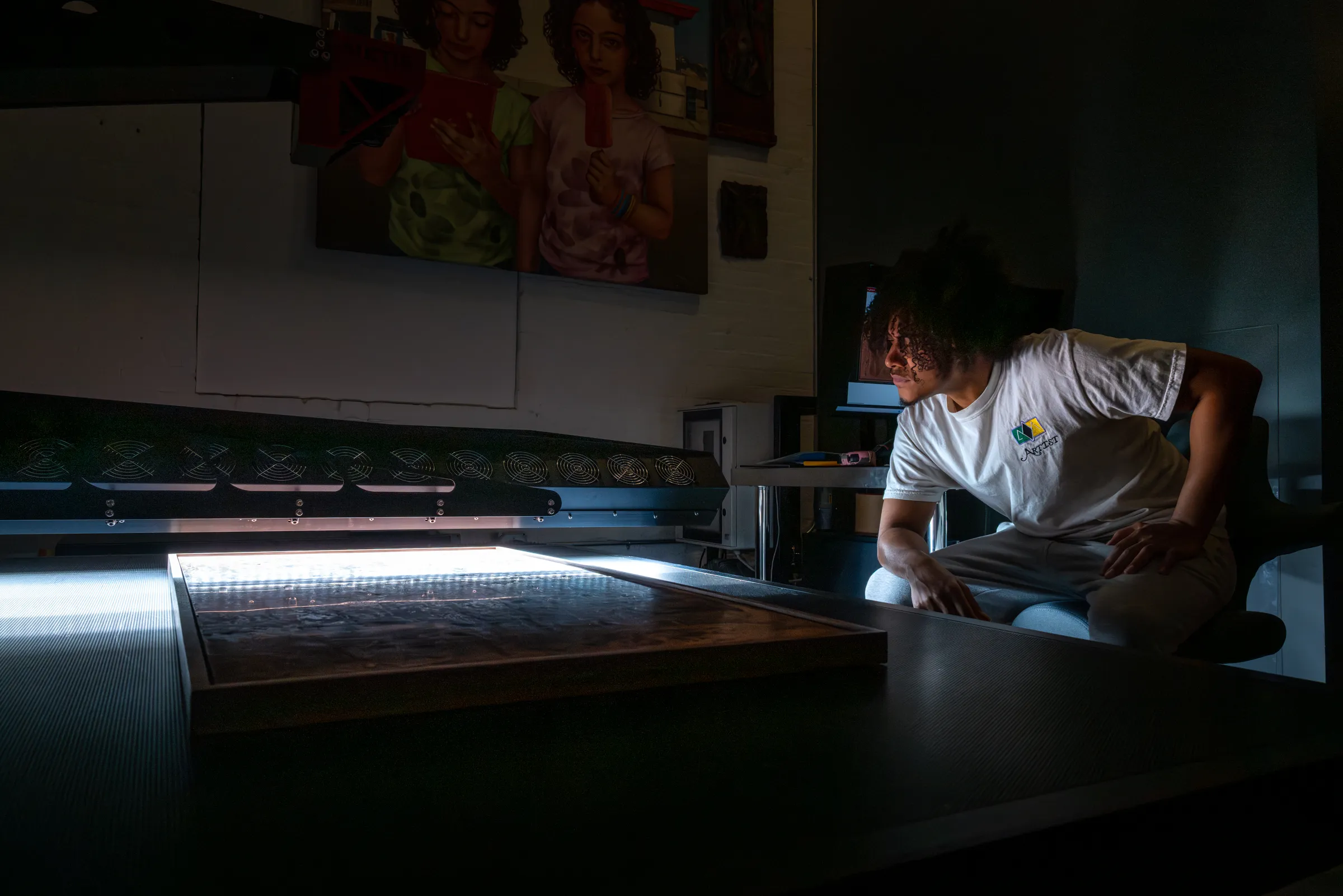

The Metis DRS 2020: Large-Format Artwork Scanning at Brooklyn Editions
Most artists, photographers, and institutions working at a professional level have never encountered a Metis scanner. They rely on photographing artwork and then encounter its limits. That path is adequate for standard-format work but falls short when the artwork is large, textured, dimensionally complex, or simply demands more fidelity than even the best professional camera and lighting equipment can deliver.
The Metis DRS 2020 is one of two instrument families — alongside the Cruse — that defines the upper tier of professional artwork digitization. Major museums, national archives, and cultural heritage institutions worldwide use it for work that other systems cannot handle. Brooklyn Editions is one of a small number of fine art studios in the United States to operate a Metis scanner, bringing this institutional-grade capability to artists, galleries, collectors, and institutions who need it for reproduction, archival, and research purposes.
This page explains what the Metis DRS 2020 makes possible — organized around the types of work and outcomes it enables, rather than its specifications. A technical reference list appears at the end for those who need the precise numbers.
The Instrument
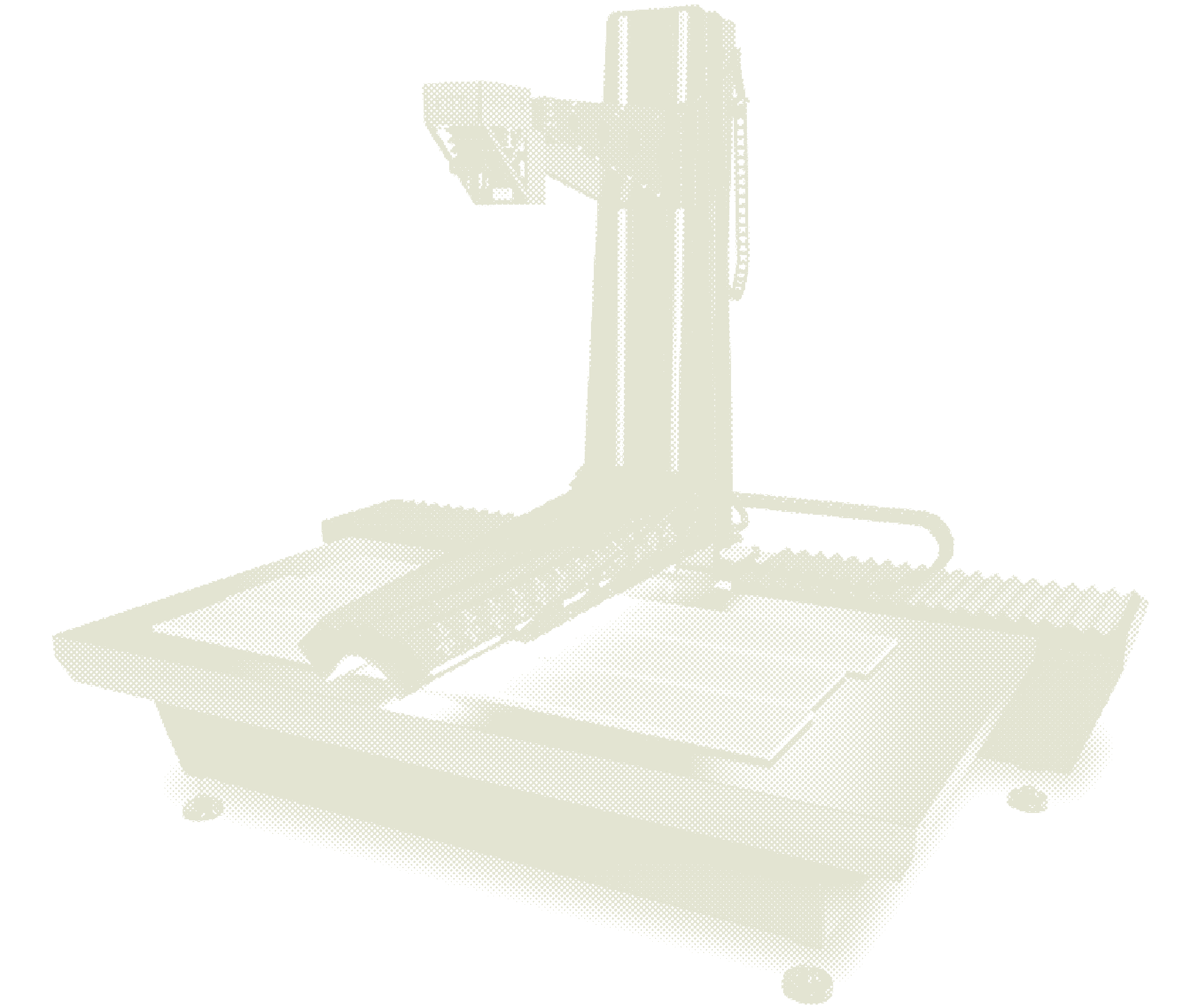
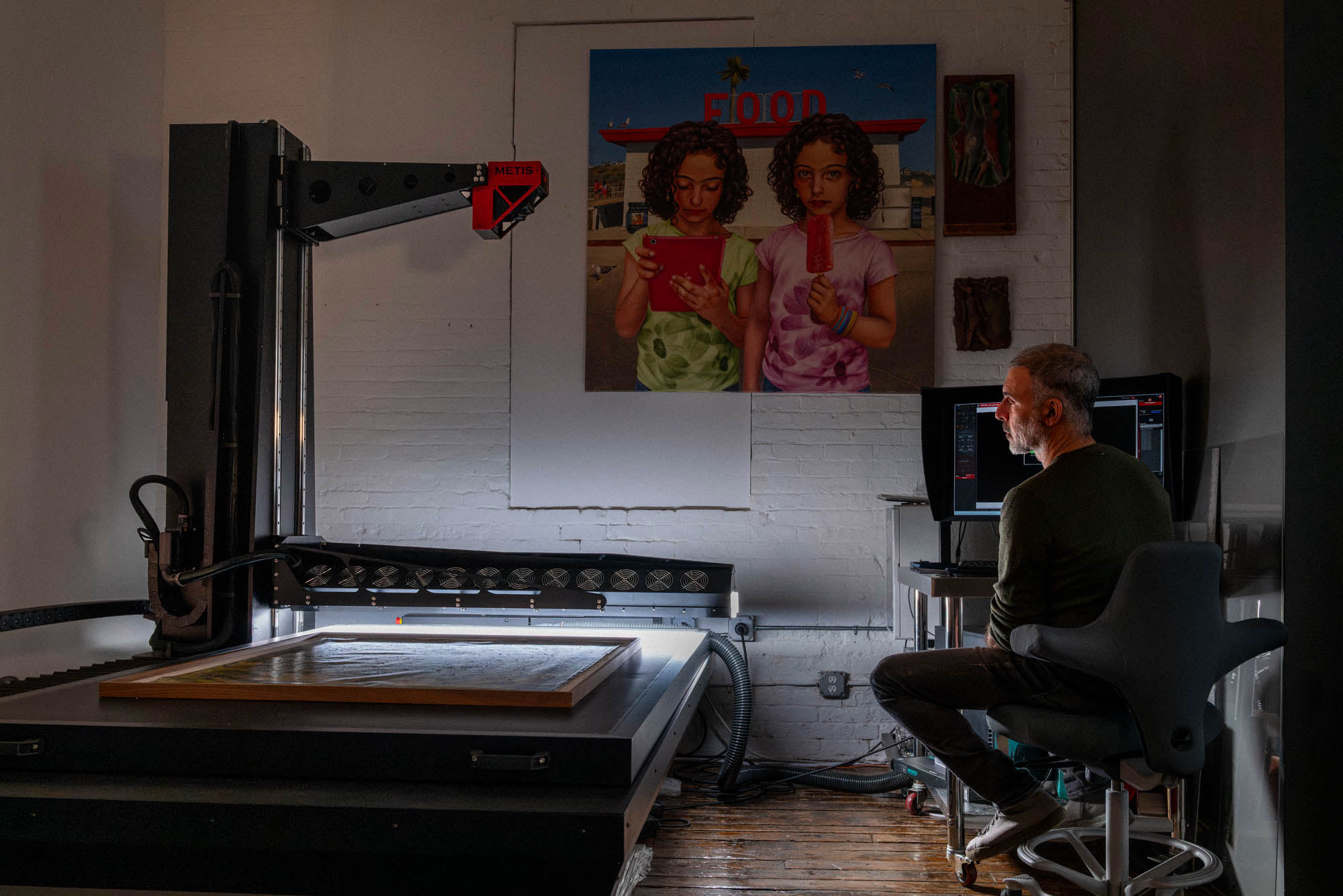
Understanding a few things about how the Metis DRS 2020 works — at a non-technical level — helps explain why it produces results that other scanning systems cannot match. The key is its architecture: a single high-resolution linear sensor that traverses the full width of the artwork in one precisely registered pass, combined with a synchronized eight-element lighting system that opens up new possibilities.
Single-Sensor, Single-Pass Capture
Many large-format scanning systems — including products marketed for artwork use — work by arranging multiple cameras side by side inside the unit, each capturing a strip of the artwork simultaneously, with the results assembled in software. This works acceptably for flat, smooth documents. For artwork — particularly work with surface texture, impasto, raised media, or any dimensional variation — it introduces inconsistencies at the seam lines between captures and produces unreliable results across surfaces that aren't perfectly flat. Each camera sees the surface from a slightly different angle, and parallax differences compound across any surface with depth.
The Metis DRS 2020 uses a single sensor throughout the entire capture. There are no internal seams, no parallax differences, no stitching of adjacent camera strips. The same optical system captures the first inch of the painting and the last. This is the architectural foundation that makes accurate texture capture, precise color consistency, and reliable dimensional data possible across the full surface of a work.
The DC Synchrolight Lighting System
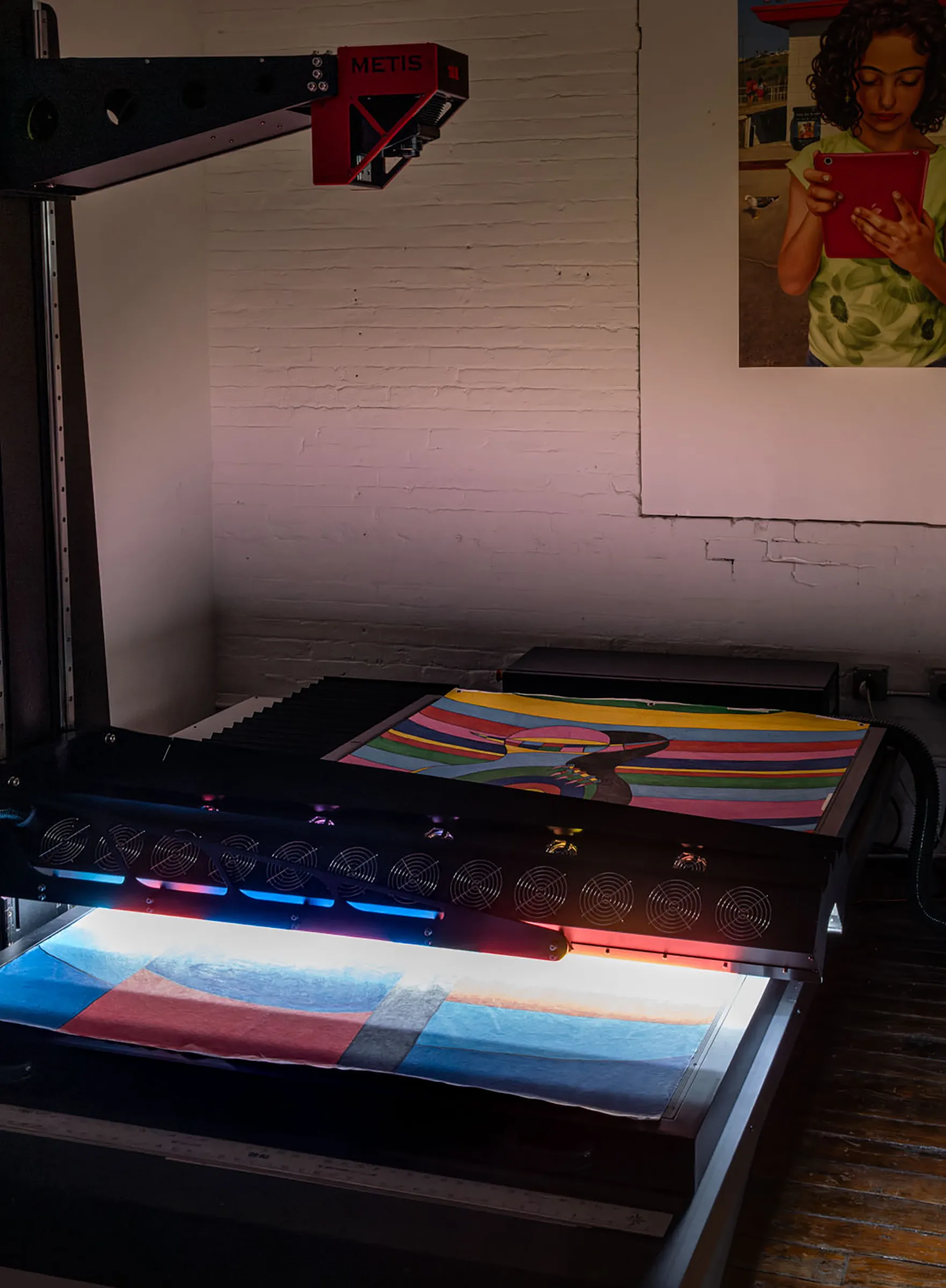
The Metis DC Synchrolight is a patented lighting system with eight independently controlled LED light sources. During a scan, the angle and intensity of each source can be varied dynamically — adjusted in real time to suit the specific surface being captured at each point in the scan. For a painting with smooth passages and heavily textured ones, the system can optimize lighting conditions across the full surface rather than compromising between the needs of different areas.
The Metis MDC SuperScan format records all lighting configurations simultaneously within a single file. This means the visual appearance of the scan — the degree of raking light that reveals texture, the balance between diffuse and directional illumination — can be adjusted and refined after the capture is complete, without the artwork needing to be present or rescanned. It is a level of post-capture control available from no other scanning system.
Contactless Capture
The scanner operates entirely without contact — no pressure is applied to the artwork surface at any point. The vacuum table holds flat and semi-flat works perfectly registered during capture without physical restraint.
Capturing Material Data, Not Just an Image
The precisely aligned light and sensor configuration, combined with sophisticated processing software, enables the scanner to capture and understand actual depth and the material qualities of the object being scanned, including its texture and glossiness.
Depth of Field
The Metis DRS 2020 offers a user-selectable depth of field that can be adjusted for the specific surface being scanned. This allows the scanning of objects and artwork that have several inches of depth, keeping dimensionally complex work in sharp focus across the full range of surface variation. That can include a detailed gold-leafed frame, a heavily textured painting, or even a guitar.
Large-Format and Oversized Artwork
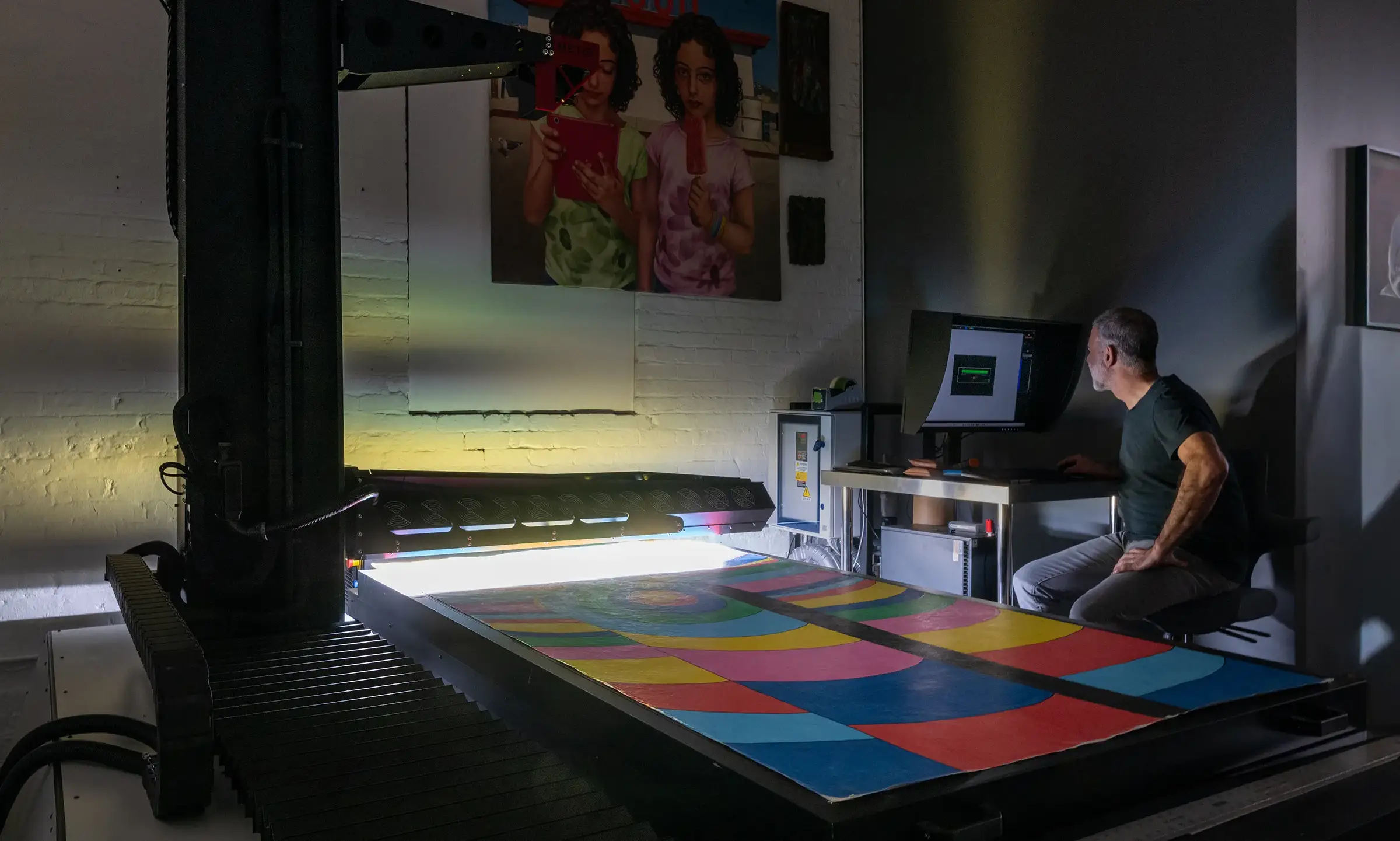
Paintings, drawings, and works on paper that are too large for conventional scanning equipment can be captured in a single pass — or stitched across multiple passes — at full professional quality.
The Metis DRS 2020 scan bed accommodates artwork up to 47 × 78 inches in a single contactless pass. For most large canvases, full-sheet watercolors, oversized drawings, and large-format photographs, this means the entire work is captured by the same sensor under consistent lighting conditions, producing a single seamless file.
For works that exceed even this footprint — mural-scale paintings, panoramic photographs, architectural drawings, large tapestries — the Scan Merge system automatically stitches multiple passes into a single seamless file with sub-pixel registration accuracy. Because all passes are made by the same sensor under the same lighting conditions, the stitched file is indistinguishable from a single-pass capture. There are no visible seams, no tonal inconsistencies between passes, no resolution degradation at the join points.
The practical implication for artists: no painting is too large for us to scan. Artists working at any scale — from intimate drawings to large studio canvases — can receive a single unified high-resolution file from their original work. For a deeper look at the logistics of oversized work, see our guide on how to scan a large painting.
Files Large Enough for Any Use
A 40 × 60 inch painting scanned at 1200 PPI produces a file 48,000 × 72,000 pixels — 3.46 gigapixels. This file can be reproduced at original scale, at four times original scale, or cropped into fine surface details for close-up reproduction, all without any perceptible quality loss. For edition production, a single master scan can support print runs in any size across the lifetime of the edition. For practical guidance on choosing capture resolution, see what resolution artwork should be scanned at.
Textured, Dimensionally Complex, and Mixed-Media Work
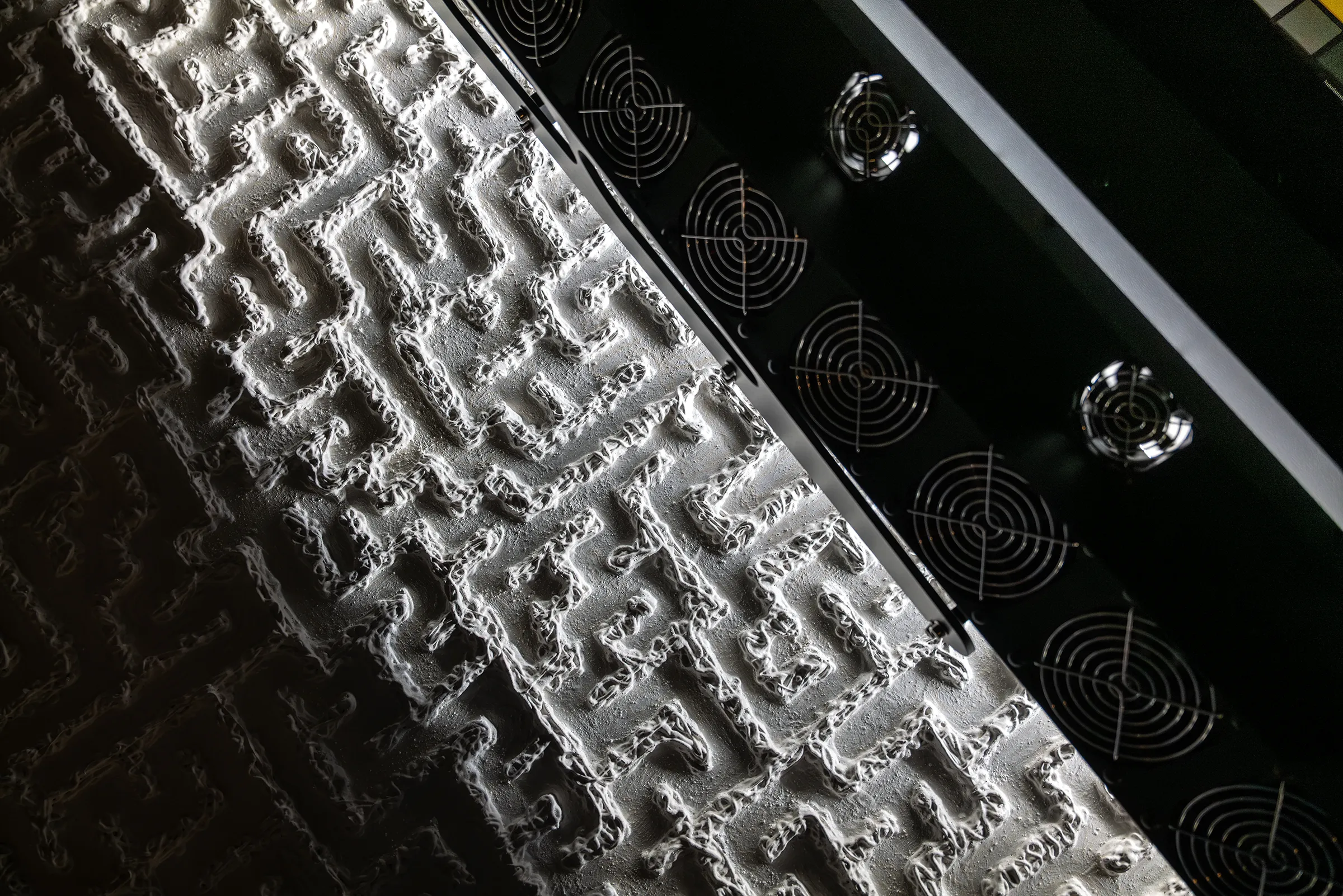
Paintings with significant surface relief, works with raised and layered media, textiles, and mixed media with dimensional elements can be captured with the surface texture, material variation, and optical depth that conventional scanning and photography cannot render.
Surface is not incidental to a painting — for many artists, it is the work. The ridge of an impasto brushstroke, the grain of a rough canvas, the layering of glazes over texture, the difference in sheen between passages of varnished and unvarnished paint — these are the physical facts of the piece that give it presence in person and that are almost entirely lost in a flat photograph or a flatbed scan.
The Metis DC Synchrolight system addresses this directly. By varying the angle and intensity of eight light sources across the scan surface, it can selectively reveal texture — rendering the shadows that make surface relief visible — without introducing the glare and reflections that directional light typically causes on complex surfaces. The result is a digital capture that retains the optical character of the original: the way light falls differently across a worked-up impasto passage versus a thinly painted glaze, the way canvas weave reads through paint layers, the subtle sheen differences between areas of different medium or finish.
Challenging Surfaces
Materials that defeat most scanning systems are handled by the Metis with consistent accuracy:
- Varnished paintings — lighting angle control and glare management preserve color and detail beneath reflective varnish layers that would blind a camera or standard flatbed scanner.
- Metallic pigments and gold leaf — dynamic lighting prevents the specular reflections that cause metallic areas to read as undifferentiated bright patches in conventional scans.
- Impasto and palette-knife work — high depth-of-field settings keep the full range of surface height in sharp focus, while directional lighting renders the relief accurately.
- Textiles and woven surfaces — the weave structure, thread character, and dimensional variation of fabric surfaces are captured with clarity rather than averaged into a flat texture.
- Collage and raised media — layered elements, adhered materials, and relief constructions are lit for relief without glare or uneven lighting, and the scanner's depth-of-field range avoids blurring or focus fall-off.
- Delicate and fragile works — contactless capture and UV-free, IR-free LED lighting mean no physical or photochemical risk to the most vulnerable originals.
Fine Art Reproduction and Edition Production
Artists and estates producing giclée editions, galleries preparing reproduction prints, and institutions supplying publication-quality files all receive master scans with the color accuracy, resolution, and file quality needed to support reproduction at any scale and any quantity — from a single proof to an ongoing open edition.
The requirements for a master scan used in edition production are exacting. The file must be large enough to support the full range of intended print sizes. The color must be accurate enough that a print produced from the file is indistinguishable from the original at careful inspection. The surface character of the work — texture, material variation, tonal subtlety — must be present in the file so that it translates into the print. And the file must remain reliably reproducible across multiple print runs, potentially years apart.
The Metis DRS 2020 addresses each of these requirements. Resolution up to 1600 PPI native produces files large enough for any print scale. Forty-eight-bit color capture (16 bits per channel) preserves the full dynamic range of the original, giving the printing workflow room to operate without loss. ICC-managed color from scan through proof to final print output ensures that a print produced today matches one produced in three years from the same file. And the surface-capture capability of the Synchrolight system means that the texture and material presence of the original are in the file — available to the printer, visible in the print.
From Scan to Print Under One Roof
For artists working with Brooklyn Editions, the scan and the print are managed by the same team in the same color-managed environment. The scan is proofed against the original artwork under calibrated viewing conditions before any edition prints are made. Color matching is not a matter of approximation — it is a verifiable step with the original present. This is the standard that edition work demands, and it is only possible when scanning and printing are handled in an integrated workflow rather than as separate services. Our fine art printing service runs from the same calibrated bench as the scanner.
3D Surface Data and Depth Mapping
Works requiring detailed surface documentation — for conservation records, scholarly analysis, embossing applications, or advanced reproduction — can receive accurate 3D depth maps and glossiness maps derived directly from the scan data, without any additional capture time or specialized equipment.
This capability is unique to Metis scanning systems and is rarely available outside major museum digitization facilities. It uses a technique called photometric stereo: by analyzing the way the surface of the artwork reflects light under the multiple distinct lighting configurations captured during a SuperScan, the software calculates the actual height variation of the surface point by point across the entire artwork. The result is a precise 3D model of the painting surface — accurate enough to document conservation conditions, guide restoration decisions, and serve as a reference for future comparison.
What 3D Data Is Used For
- Embossing and texture printing — the depth map can be used to produce prints with physical texture that replicates the surface relief of the original. For edition production where surface character is integral to the work, embossed reproduction opens possibilities unavailable from a flat file.
- Conservation documentation — a precise record of surface condition, including crack patterns, deformations, areas of paint loss, and dimensional change over time. Used as a baseline for condition monitoring and conservation planning.
- Scholarly and research analysis — surface topology data allows researchers to analyze paint application techniques, layer structure, and material characteristics in ways that two-dimensional imaging cannot support.
- Restoration reference — a pre-treatment 3D record allows conservators to document the exact surface state of a work before intervention and verify results afterward.
Glossiness Mapping
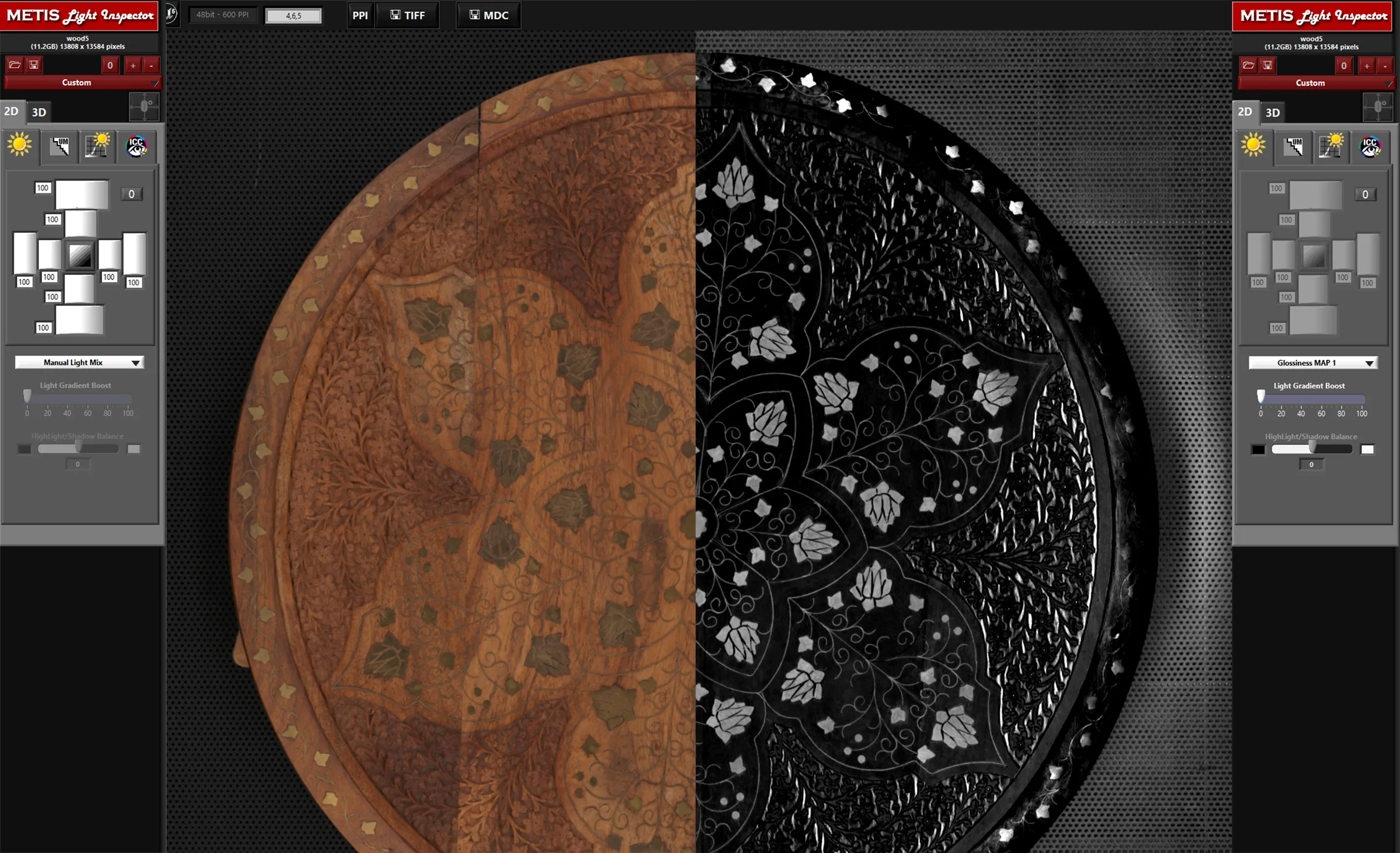
Alongside the depth map, the Metis system can generate a glossiness map: a record of the reflectivity variation across the surface of the artwork. Areas of varnish, metallic pigment, gloss medium, and unvarnished matte paint all register differently. This map has applications in conservation (tracking changes in surface finish), in printing (guiding selective coating or varnishing of reproductions), and in digital visualization (providing accurate material properties for rendering engines).
PBR Scanning for Gaming, Visualization, and Manufacturing
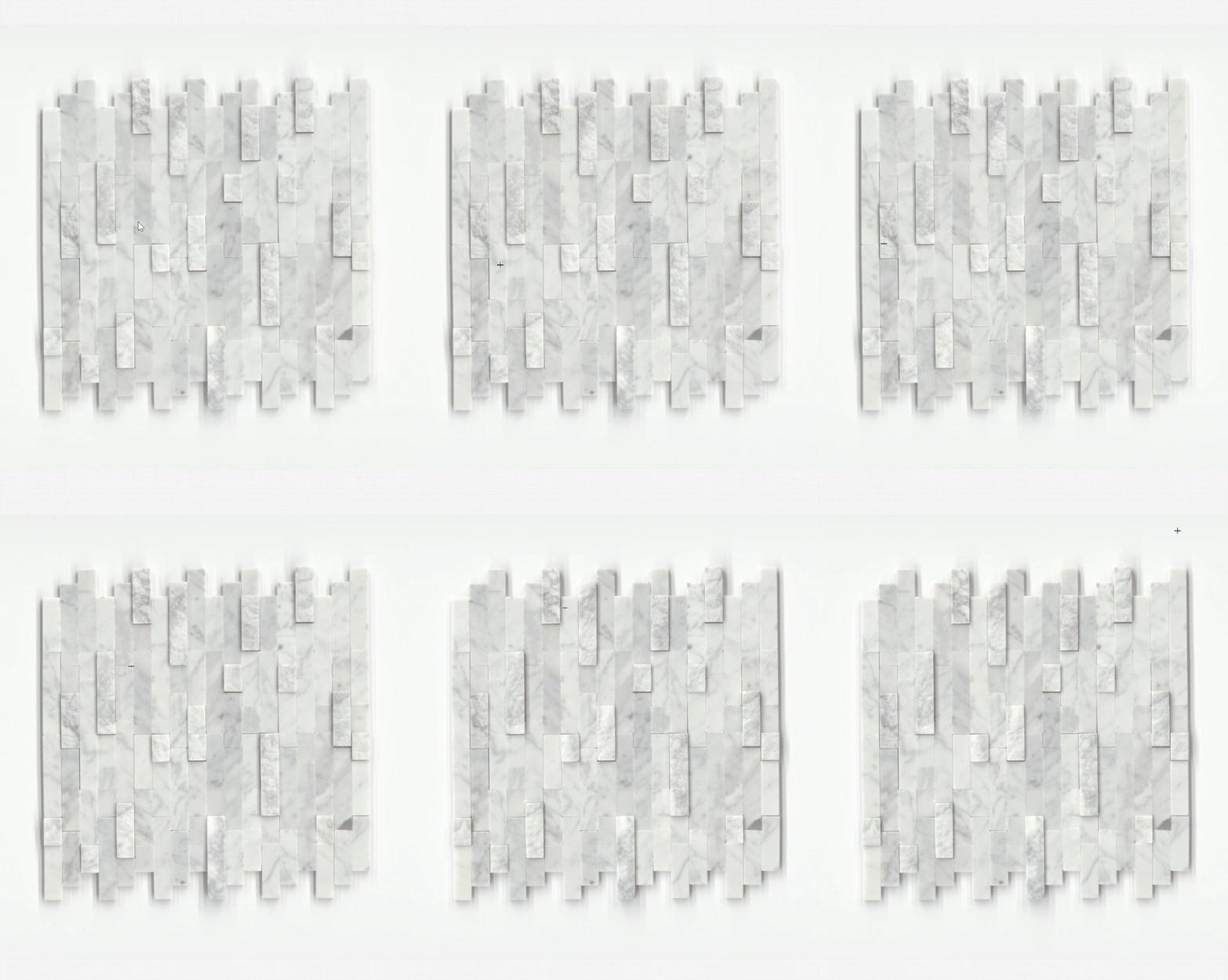
Organizations working in game development, virtual reality, architectural visualization, product design, and manufacturing can receive PBR (physically based rendering) texture sets derived from real-world material scans — wood, stone, fabric, tile, metal, plaster, and other surfaces — captured at resolutions and with material accuracy that make digital environments indistinguishable from physical ones.
PBR scanning is an extension of the same capabilities that make the Metis DRS 2020 exceptional for fine art reproduction. The DC Synchrolight system, depth mapping, and glossiness mapping together produce the full set of maps required for a PBR workflow: Color (Albedo), Normal Map, Roughness Map, Metalness Map, and Depth Map. These maps, generated simultaneously from a single SuperScan capture, allow game engines, rendering software, and visualization platforms to simulate the way a real material surface looks and responds to light with physical accuracy.
- Game development and virtual environments — photorealistic surface textures derived from real materials, with physical accuracy that procedurally generated textures cannot achieve.
- Architectural and interior visualization — accurate material representations for design presentations, client approvals, and planning applications.
- Product design and manufacturing — surface documentation and texture capture for material libraries, quality control, and digital product development.
- Heritage digitization for immersive experiences — museum artifacts, architectural surfaces, and historic materials captured for virtual reality and interactive installation.
- Textile and materials industries — woven, printed, and embossed surfaces captured at the level of detail required for digital product development and customer-facing visualization.
Metis scanning technology delivers photorealistic, high-resolution textures at up to 16K resolution, enabling faithful reproduction across most digital platforms. PBR scanning projects are handled on a consultation basis. The technical requirements — tile size, resolution, map outputs, file formats — vary significantly by application and rendering pipeline. Contact us to discuss your project before submitting.
Archival and Cultural Heritage Digitization
Museums, libraries, estates, private collections, and institutions requiring long-term digital preservation of irreplaceable originals receive scans that meet the technical standards for archival documentation and accurately represent the work for any future use — reproduction, publication, research, or loan documentation.
Archival digitization places specific demands on both the scanning system and the workflow. The digital record must be complete — capturing not just color and detail but surface condition, material variation, and dimensional character that will allow future researchers to understand the work as it existed at the time of scanning. The file must be technically robust — in a format, color space, and at a resolution that will remain useful as technology evolves. And the process must be safe for the original — no physical risk, no photochemical damage, no handling beyond what is absolutely necessary.
The Metis DRS 2020 was developed in part for exactly this application. Its contactless capture, UV-free and IR-free LED lighting, and ability to handle fragile and deteriorating originals without physical contact make it appropriate for works of any condition or sensitivity. Its DC Synchrolight system captures condition information — surface texture, paint-layer relief, crack patterns, areas of loss — that supports conservation records beyond what a standard color capture provides.
Standards and Deliverables
Institutional digitization projects often require adherence to specific technical standards — FADGI (Federal Agencies Digital Guidelines Initiative), Metamorfoze, IIIF, or institution-specific protocols. Brooklyn Editions works with clients to ensure that scan parameters, file formats, metadata, and deliverables meet the requirements of the project. Files are delivered in archival-quality TIFF format at 48-bit color depth in a wide-gamut color space, with ICC profiles and complete capture metadata.
- Condition documentation — surface state captured at the time of scanning, supporting before-and-after comparison for conservation work.
- Collection cataloguing — high-resolution master files suitable for permanent archive, insurance documentation, and loan condition reporting.
- Publication and exhibition files — derivatives for any output purpose prepared from the archival master, ensuring the archive remains the single authoritative source.
- Shipping and remote projects — works can be sent to our Brooklyn studio from anywhere; we work with art handlers and arrange secure receipt and return for institutional and collection projects.
For a fuller treatment of collection-scale work, see our guide on fine art scanning for collections, institutions, and estates.
The Professional Scanning Standard: Metis and Cruse
The Metis and Cruse scanner families represent the two primary instrument lines that define professional large-format artwork scanning at the institutional level. The world's leading museums, national archives, and conservation institutions use both. Both use the single-sensor, aligned-lighting architecture that makes accurate texture capture and geometric precision possible. Both support color-managed, ICC-profiled workflows. Both are purpose-built for the demands of fine art and cultural heritage work in ways that no multi-camera stitching system, repurposed document scanner, or camera-based capture system matches.
The key technical differences between the two families are felt mostly by the operators, since both deliver files and information no other system can. The Metis sensor and light move across the bed, whereas the Cruse keeps a fixed sensor and lighting position and moves the bed instead. Both represent a fundamentally different category of instrument from anything else on the market, and both are appropriate for the most demanding artwork digitization work. For a side-by-side look, see Metis vs. Cruse.
Brooklyn Editions operates the Metis DRS 2020, which brings the DC Synchrolight lighting system, photometric-stereo 3D capability, and SuperScan multi-lighting capture to every project. For work that would benefit from a conversation about which system best suits a specific project, we're happy to discuss the options.
Technical Specifications
- Scan format — 200 × 120 cm (~79 × 47 in)
- Maximum thickness — ~15 cm (5.9 in) at full format; up to 50 cm (19.7 in) at smaller formats
- Native optical resolution — up to 1600 PPI
- Image sensor — 16K CMOS trilinear, high dynamic range, low noise
- Bit depth — 48-bit color (16 bits per channel), independent of output format
- Lighting system — DC Synchrolight: 8 independently controlled LED sources, variable angle and intensity
- Light source type — high-CRI LEDs, UV-free and IR-free
- Capture modes — Scan, SuperScan, Direct SuperScan, DOF+ (depth of field extended)
- SuperScan outputs — Color, 3D Depth Map, Glossiness Map, Normal Map, Roughness Map, Metalness Map
- Vacuum table — separate vacuum table included (Brooklyn Editions configuration)
- Scan Merge — automatic multi-pass stitching for works exceeding single-pass bed size
- File formats — Metis MDC (SuperScan), TIFF (48 or 24-bit), JPEG
- Software — Scan Director, Light Inspector, Color Profiler (all 64-bit, Windows 10/11 Pro)
- Contact — contactless; no pressure applied to artwork at any point
Frequently Asked Questions
What makes the Metis DRS 2020 different from other large-format scanners?
The key differences are architecture and lighting. The Metis uses a single linear sensor traversing the full scan surface in one pass — unlike multi-camera systems that stitch together strips from multiple cameras. This produces a seamless, geometrically accurate file with consistent tonal and color rendering across the entire surface. The DC Synchrolight lighting system, with eight independently controlled sources, allows lighting conditions to be optimized for any surface and adjusted after capture. Together, these make it possible to accurately capture textured, dimensionally complex, and reflective surfaces that other systems cannot handle.
Can you scan very large paintings — larger than most scanner beds?
Yes. The Metis DRS 2020's Scan Merge system automatically stitches multiple scan passes into a single seamless file. Because all passes are made by the same sensor under the same lighting conditions, there are no visible seams or tonal inconsistencies in the result. We have scanned mural-scale works, panoramic photographs, and very large canvases using this method.
Can you scan framed artwork through glass?
Yes. The Metis DRS 2020's lighting controls allow us to scan framed artwork through glass in many cases, which eliminates the handling risk of deframing. We assess this on a project-by-project basis during consultation — some glass types and frame configurations work better than others.
What is SuperScan and why does it matter?
SuperScan is the Metis multi-lighting capture mode. Instead of recording a single lighting configuration, it captures all eight DC Synchrolight lighting angles simultaneously in a single proprietary MDC file. After the scan is complete, the visual appearance of the image — the balance of diffuse and directional light, the degree to which surface texture is revealed — can be adjusted without the artwork being present. For complex surfaces, this lets the optimal balance between glare control and texture revelation be found after capture rather than guessed at before it.
What is the difference between the Metis DRS 2020 and the DRS 2020 DCS Plus?
The DRS 2020 DCS Plus is the current production model from Metis and includes an integrated vacuum table. Brooklyn Editions operates the DRS 2020, which uses a separate vacuum table — functionally equivalent for all fine art scanning purposes. Both models use the same DC Synchrolight lighting system, the same 16K sensor, and the same SuperScan and 3D capability.
What is photometric stereo scanning, and what can I do with the 3D data?
Photometric stereo is a technique that derives accurate 3D surface data from 2D image captures taken under multiple distinct lighting angles. The Metis system generates this data automatically from a SuperScan capture. The resulting 3D depth map can be used for conservation documentation, surface analysis, embossed reproduction printing, and as a baseline for condition monitoring over time. The companion glossiness map records surface reflectivity variation — useful for conservation records and for driving selective coating in reproduction printing.
Do you need to remove artwork from its stretcher or frame before scanning?
Unstretched and unframed works can be scanned directly. Stretched canvases can be scanned as-is in most cases. Framed works can often be scanned through glass. We discuss the best approach for each work during consultation.
What file will I receive, and how large will it be?
Standard delivery is a full-resolution TIFF file in a wide-gamut RGB color space, color-corrected and matched to the original under calibrated conditions. File sizes vary by artwork dimensions and scan resolution — a large painting scanned at 600 PPI will produce a file in the range of 5 to 15 gigabytes uncompressed. We discuss file size and delivery format during consultation so there are no surprises at delivery.
Can you ship artwork to Brooklyn Editions for scanning?
Yes. We work with professional art handlers and can assist with arranging transport and padded masterpack shipping for smaller works. Contact us before shipping so we can coordinate receipt and track all incoming pieces. All artwork is handled under our standard Limit of Liability — we recommend clients arrange their own insurance for the value of the work during transit and in our care.
Professional Artwork Digitization at Brooklyn Editions
At Brooklyn Editions, artwork is digitized using the Metis DRS 2020 — a professional scanning system with a native optical resolution up to 1600 PPI and a scan bed capable of capturing large paintings in a single contactless pass. Every scan project begins with a consultation to discuss the artwork, its dimensions, and the intended use of the files, so that we can recommend the right resolution and workflow before any work begins.
If you're planning to reproduce artwork as prints, create an archival digital record, or produce an edition, our scanning services page has full details on the process, file delivery, and how to get started.