
Fine Art Scanning for Collections, Institutions, and Estates
The most foresighted thing an artist can do for their body of work — beyond making it — is document it properly while it is fully accessible. The same is true for galleries managing significant holdings, institutions building permanent collection records, and collectors whose works will eventually change hands. A professionally scanned, consistently documented digital archive is the foundation that supports everything that comes after: editions, publications, exhibitions, loans, sales, and the long-term preservation of an artistic legacy.
This guide is for artists thinking ahead, galleries and dealers managing artist relationships and collection inventory, institutions with ongoing digitization needs, and the professionals — auction specialists, appraisers, estate advisors — who support the documentation and transition of significant collections. It covers what professional collection scanning involves, what it produces, and how to approach it at any scale.
Artists: Building a Studio Archive
For a working artist, a professional scan archive is one of the most practical investments in a career. Every finished work that leaves the studio — sold, donated, exhibited, or simply moved into storage — becomes harder to access for documentation purposes. Scanning works before they leave, while they are still in the studio and fully available, creates a master record that serves every future need without requiring the work to be retrieved.
The Case for Scanning Before Works Are Sold
Once a work is in a collector's home, a gallery's storeroom, or an institution's collection, getting it back for scanning requires coordination, negotiation, and sometimes significant effort. Works that have been sold, loaned, or donated may be effectively inaccessible. The studio is the best place and time to document a work — not when it's already in someone else's possession.
Artists who establish a scanning practice early, documenting each finished work before it leaves the studio, build a comprehensive archive without ever needing to retrieve works from collectors. The file is always at hand for edition requests, publication inquiries, exhibition submissions, and catalogue documentation. The alternative — attempting to reconstruct an archive retroactively, coordinating access to works across multiple collections — is significantly more difficult, expensive, and ultimately uncertain.
Editions and Ongoing Production
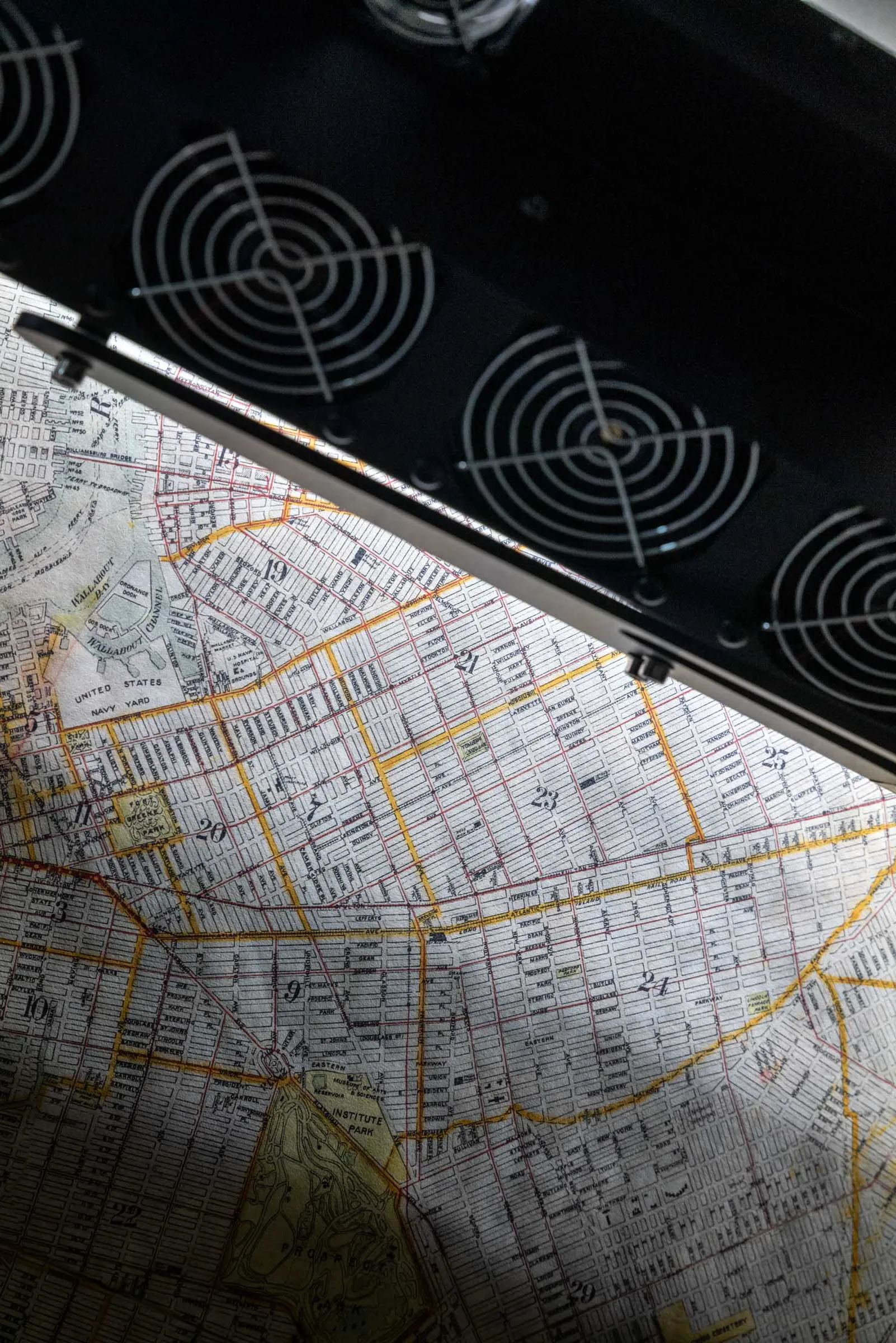
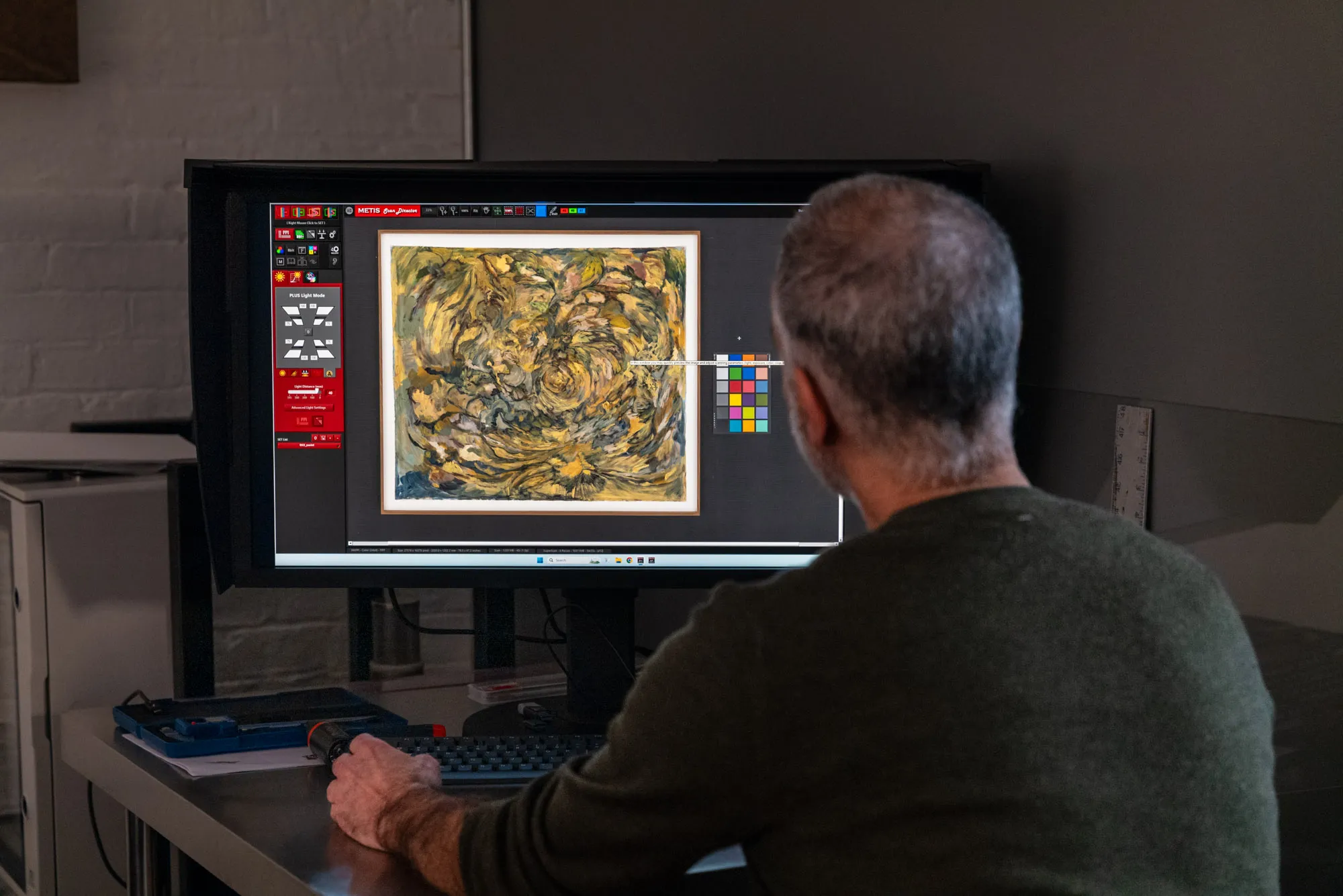
For artists who produce editions, a professional scan is the master file from which all prints are made. The quality of that master file determines the quality ceiling of every print produced from it, now and in the future. Scanning at the highest appropriate resolution, with professional color management, means the edition can be reproduced in any size and at any point without returning to the original. A master file made on a professional system like the Metis DRS 2020 — with accurate surface texture, 48-bit color, and a wide-gamut ICC profile — gives the printer everything needed to match the original faithfully across every run.
Catalogue Raisonné
A catalogue raisonné, the definitive record of an artist's complete body of work, requires image documentation that is consistent across the full body of work, color-accurate, geometrically faithful, and of sufficient resolution to support both print publication and long-term archival use. Building this record progressively, work by work as each piece is completed, is far more manageable than attempting to document an entire career retrospectively. For artists thinking about their long-term legacy, a consistent scanning practice from early in a career is the most practical foundation for this kind of documentation.
What to Discuss With the Studio
The most important consideration for a studio scanning practice is consistency and organization. A scanning studio can help establish these parameters early and apply them consistently across every session. This is a conversation worth having at the outset: deciding on the resolution, the color space, naming conventions, metadata, and the required file format or formats to use across the collection.
Galleries and Dealers: Maintaining Collection Standards
Galleries managing living artists and their estates occupy a position where documentation quality directly affects the commercial value and institutional standing of the work. A gallery that maintains professional-quality digital records of every work in its programme — scanned to institutional standards, consistently catalogued, and accessible — is better positioned for publication opportunities, museum loans, auction consignments, and private sales than one relying on ad-hoc photography of variable quality.
Artist Programme Documentation
For galleries representing living artists, establishing a scanning workflow for each artist's body of work, particularly before pieces move to collectors, creates a resource that benefits both the gallery and the artist. A complete, professional digital record of an artist's output supports catalogue production, fair and exhibition submissions, limited editions including traditional printmaking options, press and publication requests, and the long-term archiving of the gallery's programme. It also demonstrates to the artist a level of care for their work that strengthens the gallery relationship.
Inventory and Consignment Records
Works held on consignment, works in storage, and works moving between locations all benefit from a consistent digital record that establishes condition at each point of transfer. Professional scan files used as inventory documentation reduce disputes about condition at sale, provide a reliable reference for insurance and shipping purposes, and create a clear record of what is in the gallery's care at any given time.
Publication and Press
Exhibition catalogues, art fair publications, critical essays, and press coverage all require high-quality images — and consistently, the best images of a work come from a scan made when the work was new and in the studio, not from a rushed photograph taken when a publication deadline arrives. Galleries that maintain a scan archive have professional-quality images ready for any possible use without scrambling for access to works that may already be in private collections.
Institutions: Collection Digitization and Ongoing Documentation
Museums, university collections, corporate art holdings, and foundation collections all face a common challenge: maintaining a digital record of their holdings that meets formal technical standards and remains adequate for every use that arises over time — exhibition, loan, publication, conservation, and public access.
Building a Collection Archive
For institutions with collections that predate professional digital documentation — or whose existing digital records were made to lower standards — a systematic scanning project can bring the entire collection up to a consistent, professional baseline. Working through a collection in a planned sequence, a scanning studio can document every work to a uniform standard: the same resolution, the same color management workflow, the same file format and metadata structure throughout. The resulting archive is immediately useful for any institutional purpose — it can be integrated with a collection management system, used as the source for publication and loan images, shared with researchers and scholars, and serves as the definitive condition record for each work at the time of scanning.
Technical Standards Compliance
Institutional digitization is often governed by formal technical standards. FADGI (Federal Agencies Digital Guidelines Initiative) specifies technical requirements for still-image capture including resolution, bit depth, color accuracy, and metadata. Metamorfoze and other frameworks impose similar requirements, and auction houses have their own submission standards. Professional scanning on calibrated systems, delivered with ICC profiles and full capture metadata, satisfies these requirements in ways that most photographic documentation cannot consistently achieve. For institutions planning a collection digitization project, establishing the applicable standards at the outset — and selecting a scanning studio with the equipment and workflow to meet them — prevents the need to redo work that doesn't comply. We work to your specifications and can confirm compliance with specific standards as part of the project deliverables.
Loan Condition Documentation
Outgoing loans require condition reports — documentation of a work's state at the point of departure and return. A high-resolution scan made before a loan departs provides a complete, objective record of the work's surface condition, color, and physical state at a specific date. This protects both the lending and borrowing institution and provides a reliable reference in any dispute about condition upon return.
Conservation Records
For works undergoing conservation treatment, a professional scan before treatment begins creates a precise before record — color, surface texture, and, for works scanned with the Metis photometric stereo capability, a 3D depth map of the surface that documents physical relief and condition. A scan after treatment completes the record. Comparing before and after scans provides an objective measure of any change in surface state that visual comparison alone cannot match.
Auction Houses and Sale Documentation
Whether a work is being offered through a major auction house, through a gallery private treaty sale, or directly between parties, the quality of the digital documentation is part of what is being presented to buyers. Professional scan files — geometrically accurate, ICC color-managed, with resolution sufficient for large-format reproduction — communicate a level of care for the work that affects how it is perceived and valued.
Auction House Standards
Major auction houses have their own imaging standards, and works consigned with professional scan files that meet those standards reduce the documentation burden at consignment. For significant works, auction house specialists increasingly expect high-resolution, technically characterized files rather than photographs. A professional scan delivered with full metadata establishes the work's condition and appearance objectively, which supports both the auction house's cataloguing process and the buyer's due diligence.
Private and Gallery Sales
For gallery-led sales or private transactions, high-resolution scans allow the work to be presented to prospective buyers anywhere in the world before it is physically moved. This matters when a collection is geographically dispersed, when international buyers are involved, or when the logistics of viewing works in person are complicated. A buyer who can examine a work in full resolution — zooming into surface texture, color, and condition detail — is better placed to make a decision without being physically present.
Estate Documentation
The documentation needs of an estate are, in many ways, the same as those of a well-managed collection — the difference is urgency and the absence of the artist's own guidance. Works may be in multiple locations, in varying states of preservation, and subject to timelines driven by legal process, insurance review, or planned sale. The decisions made about documentation during this period have long-term consequences: files that don't meet technical standards required by auction houses, institutions, or major buyers will need to be redone at additional cost, with the originals potentially no longer accessible.
Establishing a professional scan archive before an estate situation arises — through the studio scanning practices and gallery documentation described above — is the most effective estate planning an artist can undertake for their body of work. For estates where that archive doesn't exist, a collection scanning project conducted during the estate settlement process creates the foundation that every subsequent use of the work will depend on. For the artist-side groundwork, see our guide on digitizing an artist estate.
Distribution Among Heirs and Beneficiaries
When an estate distributes works among multiple heirs or beneficiaries, a complete digital record of every work — with accurate color, consistent documentation, and formal metadata — prevents future disputes about the condition of works at the time of transfer. Each recipient can receive high-resolution files of the works they receive, along with a record of works that went to others. Highly accurate facsimile prints can also be made, so each beneficiary has a physical work as well.
Insurance and Probate
Fine art insurance and probate proceedings that include artwork both require documentation sufficient for valuation and, in complex cases, for legal proceedings. A professionally scanned and catalogued collection provides a clear, objective, and defensible record of what exists, in what condition, and when it was documented. Files delivered with full metadata — dimensions, scan date, resolution, color profile — create an audit trail that supports appraisal and legal processes. For significant estates, the investment in professional scanning is a straightforward risk-management decision.
How Collection Scanning Works
Scanning a collection — whether ten pieces or several hundred — is a carefully managed, choreographed project rather than a series of individual appointments. Understanding how the process is organized helps artists, gallery directors, collection managers, and institutional clients plan effectively.
Assessment and Planning
Every collection project begins with an assessment: reviewing an inventory of the works to be scanned, noting dimensions, media, and any condition issues or special handling requirements, and establishing the technical specifications — resolution, bit depth, color space, file formats, metadata requirements, and any applicable technical standards. This is also where the scanning sequence is planned, logistics are discussed, and a written cost and timeline estimate is produced before any work begins.
Phasing and Sequencing
Large collections are typically scanned in phases — organized by location, by priority, or by logical groupings. Works from a single estate or gallery may be held in multiple locations. A phased approach allows the project to proceed without requiring all works to be in one place simultaneously. Priority works — those with immediate documentation needs, upcoming sale deadlines, or publication requirements — are typically scheduled first.
Consistency Across the Collection
The defining quality of a professionally managed collection scanning project is consistency. Every work is scanned within the same standards, in the same color space, with the same calibration and color management workflow. The hundredth work documented matches the first. For catalogue raisonné, institutional documentation, and any collection where files will be presented together, this consistency is the difference between a professional archive and an assemblage of images made at different times to different standards.
File Deliverables
Standard deliverables for collection scanning projects:
- Full-resolution TIFF files, 48-bit (16-bit per channel) RGB, one per work.
- Wide-gamut color space with embedded ICC profile.
- Color-corrected and matched to the original under calibrated viewing conditions.
- Capture metadata: scan date, resolution, color profile, equipment.
- Preview JPEG files for catalogue, web, and reference use.
- CMYK conversions for publication use, upon request.
- File naming convention aligned with collection inventory.
- Delivery on physical drive or secure digital transfer.
- Written condition observations and handling notes, upon request.
- 3D depth maps for conservation documentation, upon request (Metis photometric stereo).
For institutional projects with specific technical requirements — FADGI compliance, particular metadata schemas, file naming conventions aligned with a collection management system — these are incorporated during the assessment. We work to your specifications.
Working With Collections Remotely
Collection projects frequently involve works held in multiple locations — storage facilities, private residences, galleries, studios, or institutions that may be outside New York. We work with remote clients regularly and have established processes for receiving, scanning, and returning works that are shipped or transported to our studio. We can also arrange for works to be scanned with our network of other professional scanning studios when possible, to ensure a consistent approach that employs coordinated standards.
Arranging Transport
For small groups of works, we can assist with arranging transport through professional art handlers, or advise on appropriate packing for works being shipped independently. For larger collection projects, we coordinate with art handling companies to manage collection, transport, temporary storage, scanning, and return. All works received are tracked from arrival to return: we confirm receipt, note any visible condition issues at arrival, and maintain a custody record throughout. Works are released when all invoices are settled and a confirmed return arrangement is in place.
Coordinating With Multiple Parties
Collection and estate projects often involve multiple stakeholders — gallery directors, appraisers, attorneys, family members, or institutional representatives. We're accustomed to this kind of coordination and can adapt our communication and deliverable structure to support each party's needs. If any stakeholder requires specific documentation — written scan specifications, chain-of-custody records, or technical standards compliance confirmation — these can be provided as part of the project deliverables.
Frequently Asked Questions
When is the best time for an artist to start building a scan archive?
As early as possible, and ideally before the works start leaving the studio. The window to document a work on your own terms — while it's accessible, in good condition, and under your control — closes the moment it's sold or transferred. Artists who establish a scanning practice early, documenting each significant piece before it leaves the studio, build a comprehensive archive without ever needing to retrieve works from collectors. Starting late is still better than not starting at all, but starting early costs much less effort.
Can you establish a consistent scanning standard for an ongoing studio practice?
Yes — this is one of the most valuable things a scanning relationship can provide. During an initial consultation, we establish the technical parameters for your archive: resolution, color space, bit depth, file format, and naming convention. Every subsequent session uses the same parameters, producing a collection of files that are uniform and interchangeable. You don't need to make these decisions each time — the standard is set once and applied consistently.
How long does it take to scan a full collection or estate?
A collection of 20 to 30 mid-size works can typically be completed within a week including processing and color correction. Larger collections are phased over several weeks or months, organized by location or priority. We provide a timeline estimate during the initial assessment once we have a full inventory.
What technical standards do your files meet?
Our standard workflow delivers 48-bit TIFF files in a wide-gamut color space with a custom ICC profile embedded — meeting or exceeding the requirements of most institutional digitization standards, including FADGI three-star and four-star specifications. If your project requires compliance with a specific standard, discuss this during the assessment and we'll confirm whether your specifications can be accommodated. We can also provide logs and metadata for each scan.
Do works need to come to your studio, or can you come to us?
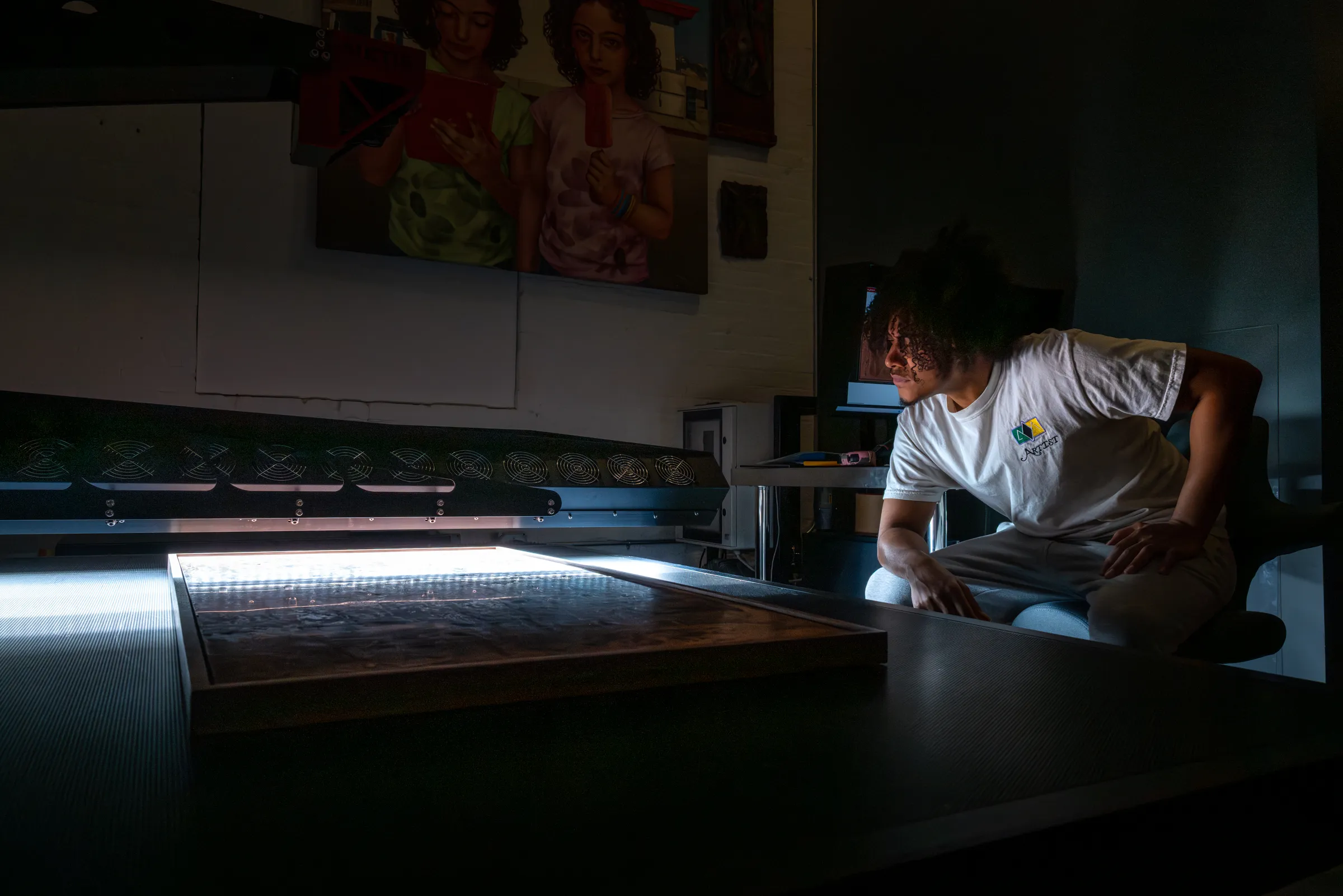
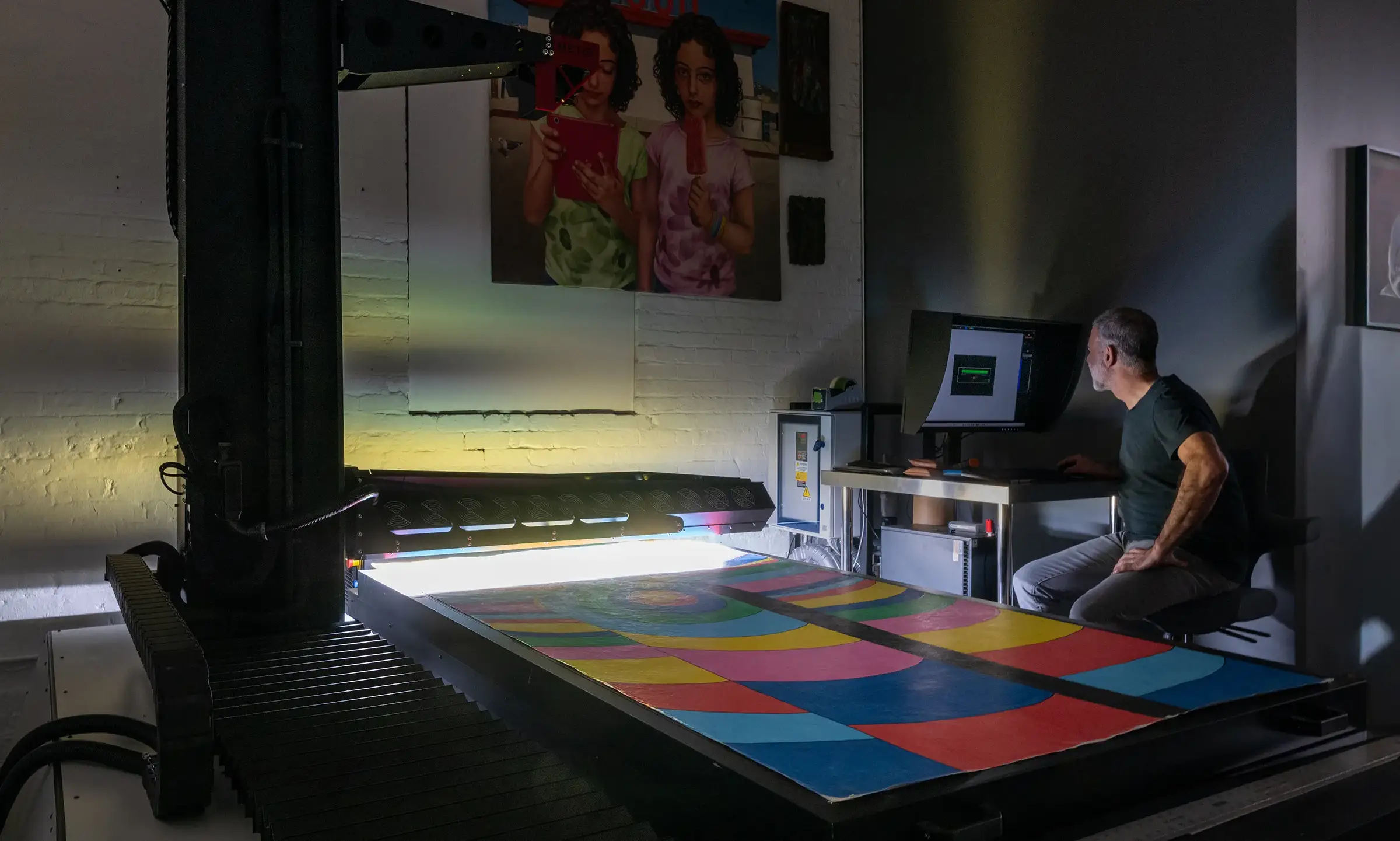
Professional large-format scanning requires the studio infrastructure — the scanner itself is the size of a car and weighs almost a ton — and cannot be brought on location. Works need to come to our Brooklyn studio. We assist with transport logistics and can coordinate with professional art handlers for collection-scale projects. For works that genuinely cannot be transported, camera-based photography at the location is the alternative; contact us and we can provide referrals.
Can you scan works that are currently in storage?
Yes. Works in art storage facilities can be transported to our studio for scanning and returned to storage afterward. We work with professional art handlers and coordinate transport logistics. If works are stored in or near New York, this is straightforward to arrange. For collections stored at greater distance, we discuss logistics and advise on the most practical approach.
Can you integrate files with our collection management system?
Yes. We deliver files with naming conventions, folder structures, and metadata fields aligned with most collection management systems — TMS, Argus, EmbARK, Gallery Systems, and others. Discuss your system's requirements during the initial assessment and we'll confirm the file structure and metadata format that works for your workflow.
Can you provide condition documentation alongside the scan?
We can provide written condition observations — notes on visible surface state, any damage or deterioration visible at the time of scanning, and handling notes — as part of the project deliverables. For works requiring formal conservation condition reports, we recommend involving a qualified conservator; we can coordinate with your conservator and work alongside them as needed.
Professional Artwork Archiving at Brooklyn Editions
Brooklyn Editions digitizes artwork on the Metis DRS 2020 — a contactless system with a native optical resolution up to 1600 PPI and a scan bed that captures large paintings in a single pass — and delivers color-managed, wide-gamut master files built to serve as a lasting archival record. Every project starts with a consultation about the work, its scale, and how the files will be used, so the resolution, format, and color space are right before any capture begins. To plan an estate, collection, or institutional archive, our scanning services page covers the process and file delivery; the rest of this artwork archiving series goes deeper on formats, estates, and museum standards.