
How Metis Scanners Capture Surface Texture
Quick answer
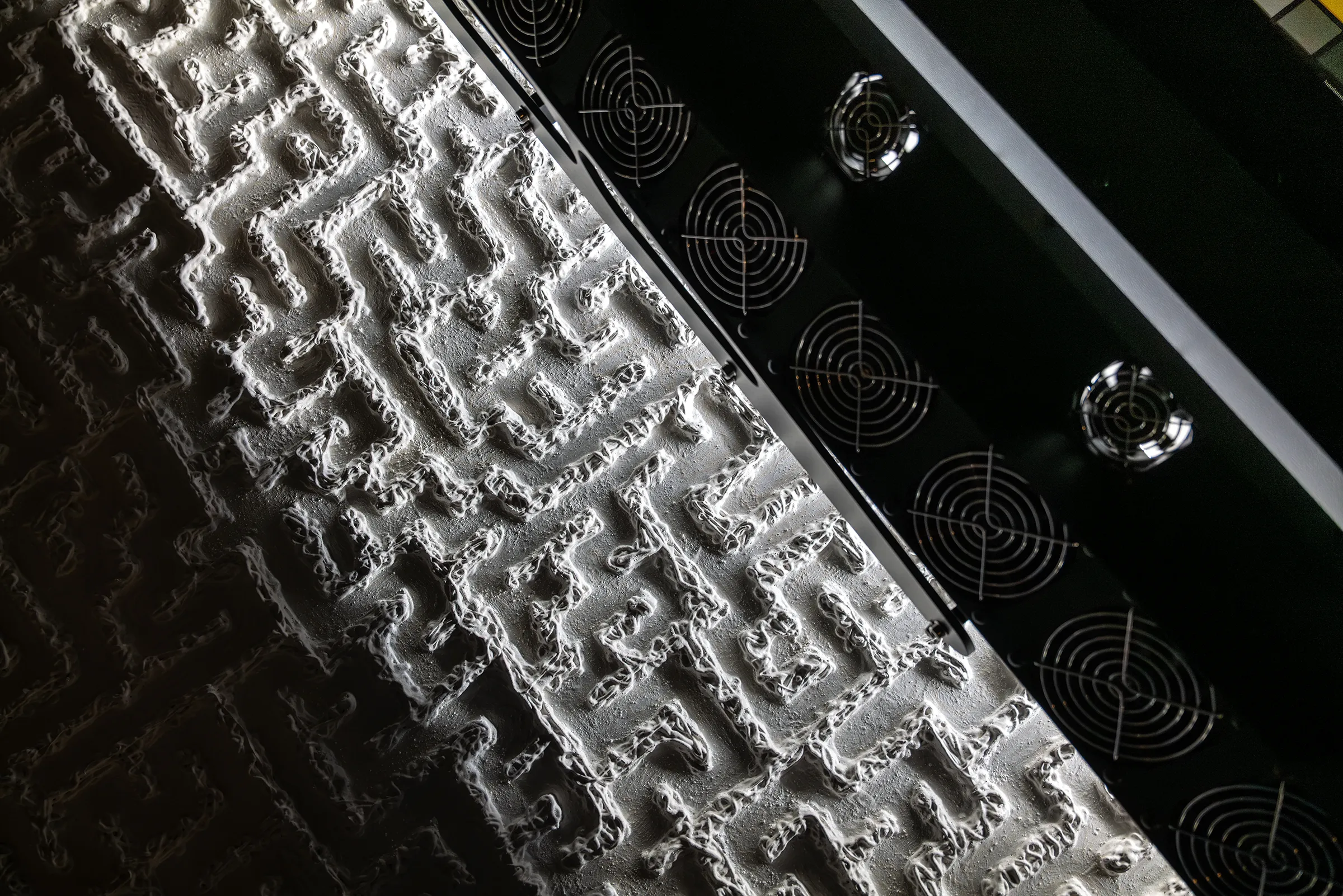
The Metis DRS 2020 captures surface texture by lighting the artwork from multiple controlled angles during the scan. Its DC Synchrolight system uses eight independently controlled LED sources whose angle and intensity vary across the surface, casting the directional shadows that make relief — an impasto ridge, the tooth of canvas, a raised collage element — visible in the file, while managing the glare that directional light usually causes on glossy or varnished passages. All of those lighting configurations are recorded together in a single SuperScan file, so how strongly texture is revealed can be adjusted after the scan, without the artwork present. From the same multi-angle data, the system can derive a true 3D depth map of the surface using photometric stereo.
The rest of this article explains why surface is so hard to capture, how directional and multi-angle lighting solves it, and what the resulting surface data can be used for. The technical details here are grounded in the Metis DRS 2020 we operate.
Why surface texture is hard to capture
For many paintings, the surface is not incidental — it is the work. The ridge of an impasto brushstroke, the grain of rough canvas, the layering of glazes over texture, the difference in sheen between varnished and unvarnished passages: these are physical facts that give a piece its presence in the room. They are also almost entirely lost in a flat photograph or a fixed-light flatbed scan.
The reason is lighting. What makes texture visible to your eye is the way light falls across it at an angle, throwing small shadows that read as relief. A flatbed uses a single fixed light and cannot vary that angle, so it flattens everything into an even, characterless field of color. A camera can use angled studio lights, but it records the whole surface at once from one viewpoint — so the lighting angle is correct in one part of the frame and wrong everywhere else, and directional light strong enough to reveal texture also produces glare the camera cannot separate from the image.
Capturing surface faithfully means controlling the lighting angle precisely, keeping it consistent across the entire work, and managing reflections at the same time. That is the problem the Metis lighting system is built to solve.
How directional and multi-angle lighting works
The Metis DRS 2020 pairs a single linear sensor that traverses the full width of the artwork with the DC Synchrolight lighting system — eight LED sources, each independently controlled, whose angle and intensity can be varied dynamically as the scan progresses.
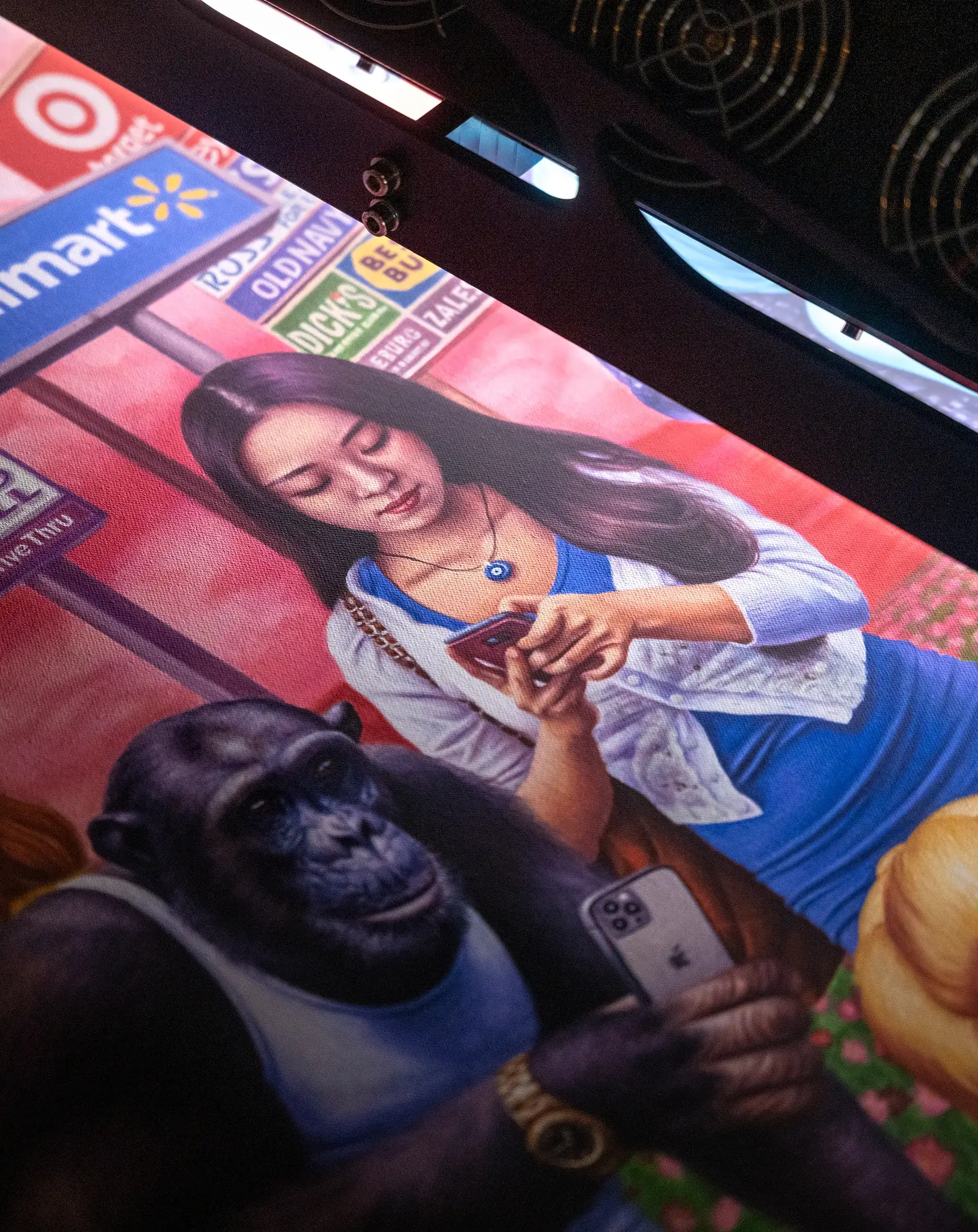
Two properties make this work for texture. First, the lighting moves in registration with a single line of capture: every pixel is recorded under the same light angle, parallel to the work, rather than the shifting angle a camera sees across a large surface. That consistency lets the file represent texture truthfully from edge to edge. Second, because there are multiple sources at controllable angles, the system can introduce directional, raking-style light to reveal relief where a work needs it — and balance it against diffuse light to keep glare and specular hotspots under control. A painting with both smooth and heavily textured passages can be optimized across its full surface, rather than compromised to one setting that suits neither.
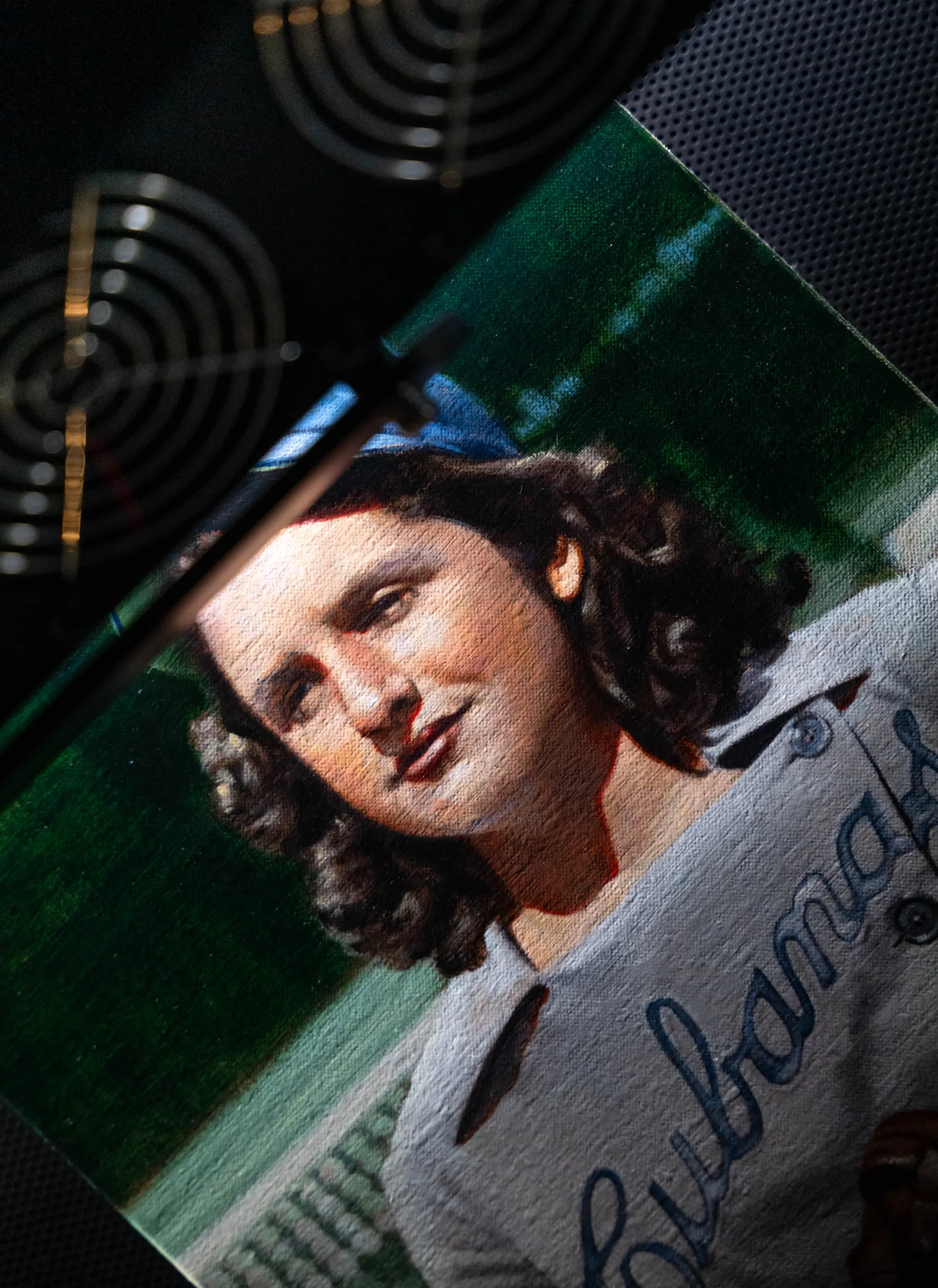
The result is a digital capture that retains the optical character of the original: the way light falls differently across a worked-up impasto passage versus a thinly painted glaze, the way canvas weave reads through paint layers, the subtle sheen differences between areas of different medium or finish. For the underlying principle of how lighting angle reveals or flattens texture, see directional lighting in art scanning.
SuperScan: deciding how much texture to show, after the fact
On most scanning systems, the operator chooses one lighting configuration before capture and is committed to it. If the balance between revealing texture and controlling glare turns out wrong, the artwork has to come back in.
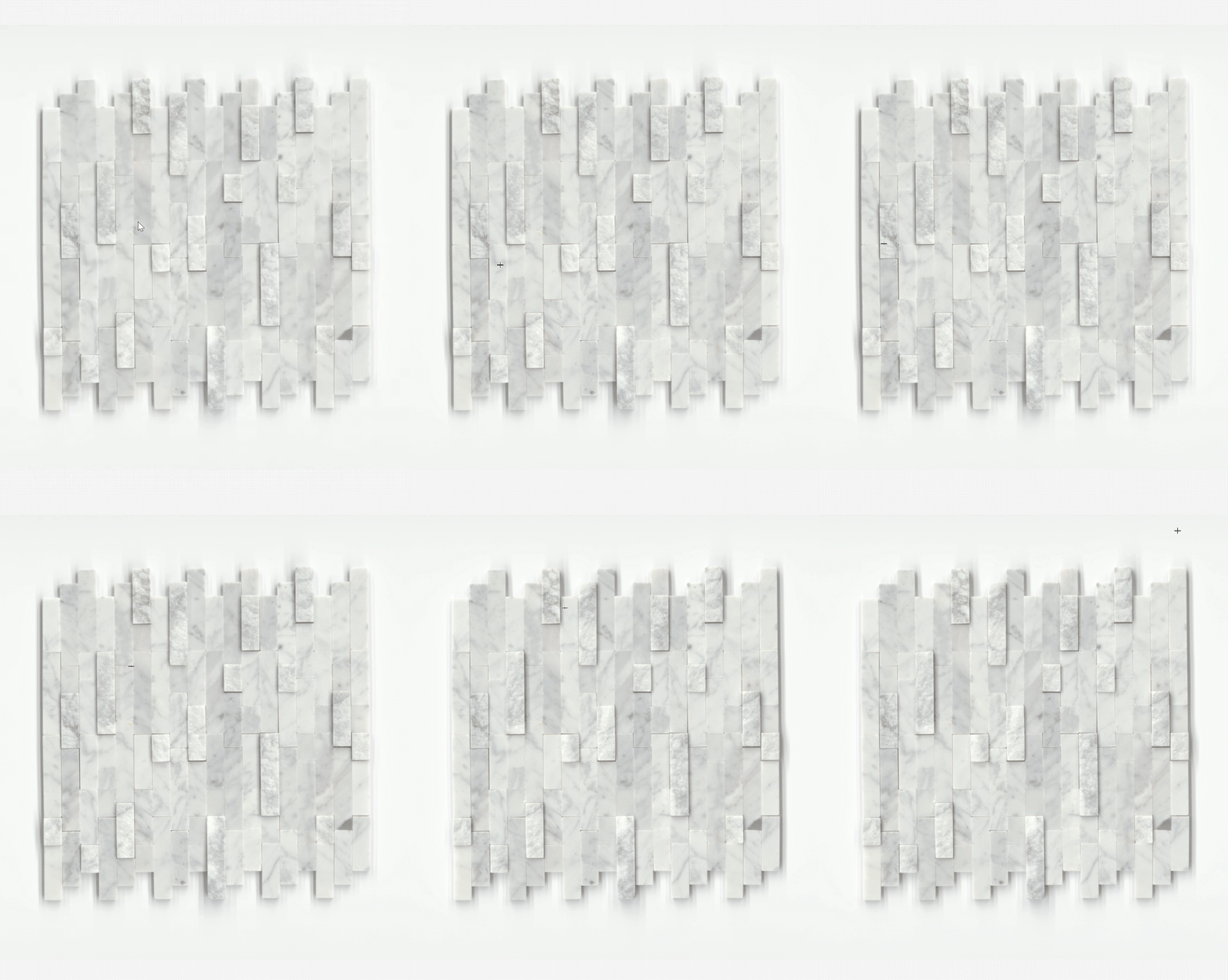
The Metis SuperScan mode (recorded in its proprietary MDC file format) captures all of the DC Synchrolight lighting configurations simultaneously in a single file. The practical consequence is significant: the visual appearance of the scan — how diffuse or directional the light reads, how strongly surface relief is emphasized — can be adjusted and refined after the capture is complete, without the original being present or rescanned. For a complex surface, the optimal balance between glare control and texture revelation can be found after the fact rather than guessed at beforehand. It is a level of post-capture control that depends on recording the multi-angle data in the first place.
Surfaces and materials this handles
Recording surface under controlled multi-angle light is what lets the Metis handle materials that defeat conventional scanning and photography:
- Impasto and palette-knife work. High depth-of-field settings keep the full range of surface height in sharp focus, while directional lighting renders the relief accurately rather than flattening it.
- Varnished paintings. Lighting-angle control and glare management preserve color and detail beneath reflective varnish layers that would blow out a camera or a standard flatbed.
- Metallic pigments and gold leaf. Dynamic lighting prevents the specular reflections that otherwise cause metallic areas to read as undifferentiated bright patches.
- Textiles and woven surfaces. Weave structure, thread character, and dimensional variation are captured with clarity rather than averaged into a flat texture.
- Collage and raised media. Layered elements and adhered materials are lit for relief without glare, and the depth-of-field range keeps them in focus without fall-off.
The contactless capture matters here too: no pressure is applied to the surface at any point, and the UV-free, IR-free LED lighting means no photochemical risk to fragile or delicate originals.
From texture to 3D: photometric stereo
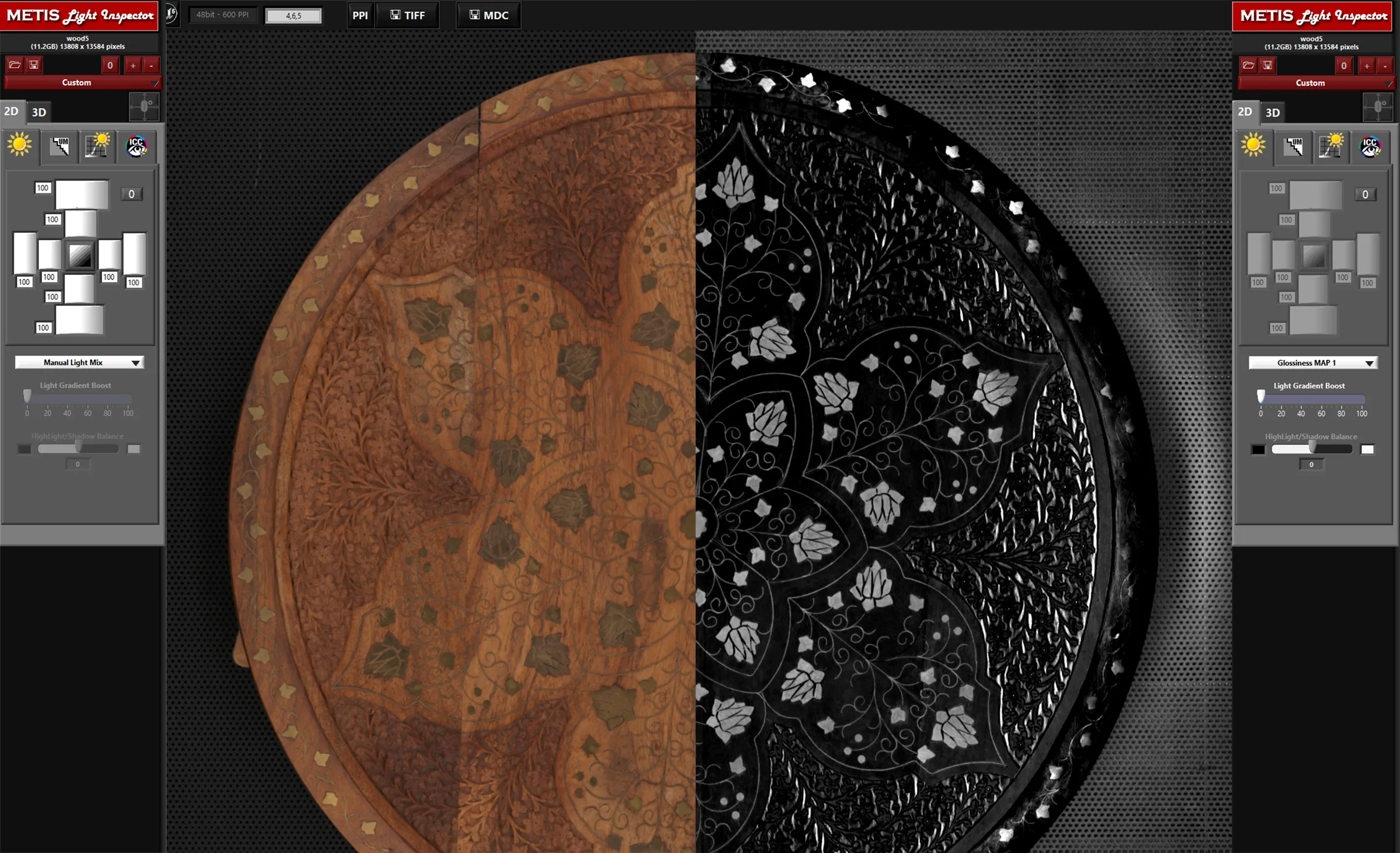
Because the Metis records the surface under multiple distinct lighting angles, it can do something a single capture cannot: calculate the actual height of the surface, point by point. The technique is called photometric stereo. By analyzing how the surface reflects light under each of the configurations captured in a SuperScan, the software derives an accurate 3D depth map of the work — and, alongside it, a glossiness map recording how reflectivity varies across the surface (varnish, metallic pigment, gloss medium, and matte paint all register differently).
This surface data has real uses beyond a richer flat image:
- Embossed and texture reproduction. The depth map can drive prints with physical relief that echoes the original surface.
- Conservation documentation. A precise record of surface condition — crack patterns, deformation, areas of loss — serves as a baseline for monitoring change over time.
- Research and analysis. Surface topology lets scholars study paint application and layer structure in ways flat imaging cannot support.
This level of surface documentation is rarely available outside major museum digitization facilities.
Frequently asked questions
How does the Metis DRS 2020 capture surface texture?
It lights the artwork from multiple controlled angles during the scan. The DC Synchrolight system uses eight independently controlled LED sources whose angle and intensity vary across the surface, casting directional shadows that make relief visible while managing glare. All lighting configurations are recorded together in a SuperScan file, so texture emphasis can be adjusted after capture.
Can a flatbed scanner capture impasto and canvas texture?
Not well. A flatbed uses a single fixed light and cannot vary the angle across the surface, so it flattens texture into an even field of color. Revealing relief requires controlled directional lighting consistent across the entire work, which is what a professional system like the Metis provides.
What is photometric stereo, and what can the 3D data be used for?
Photometric stereo derives accurate 3D surface height from images captured under multiple lighting angles. The Metis generates this automatically from a SuperScan capture. The resulting depth map supports embossed reproduction, conservation documentation, and surface research, and a companion glossiness map records reflectivity variation across the work.
Is the process safe for fragile or varnished works?
Yes. Capture is contactless — no pressure is applied to the surface — and the LED lighting is UV-free and IR-free, so there is no photochemical risk. For varnished and reflective works, lighting-angle control preserves color and detail beneath surfaces that would otherwise produce glare.
Professional Artwork Digitization at Brooklyn Editions
At Brooklyn Editions, artwork is digitized using the Metis DRS 2020 — a professional scanning system with a native optical resolution up to 1600 PPI and a scan bed capable of capturing large paintings in a single contactless pass. Every scan project begins with a consultation to discuss the artwork, its dimensions, and the intended use of the files, so that we can recommend the right resolution and workflow before any work begins.
If you're planning to reproduce artwork as prints, create an archival digital record, or produce an edition, our scanning services page has full details on the process, file delivery, and how to get started.